
Sudan Warns of Possible Military Response to Ethiopian Drone Attacks
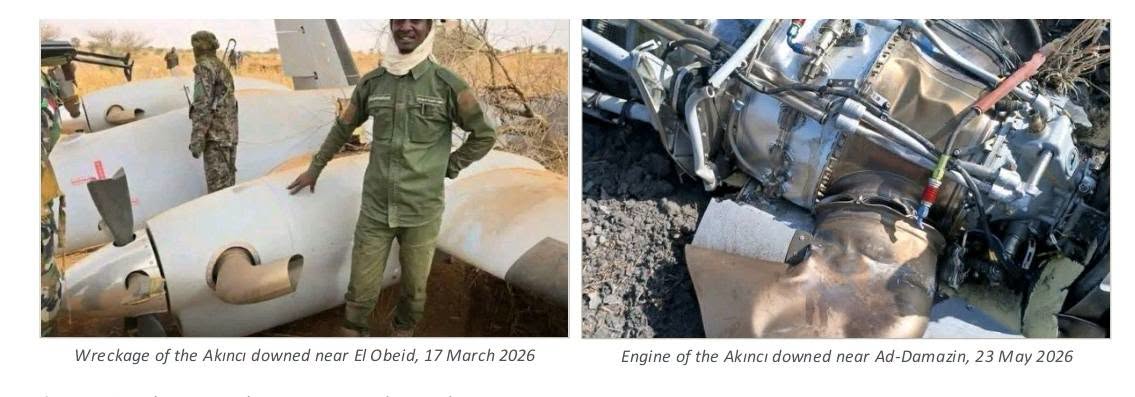
The Sudanese government, through the Advisory Board of the Transitional Sovereignty Council (TSC), has issued an extensive field-based and scientific report entitled “Launched from Ethiopia”. The report presents forensic, geospatial and documentary evidence accusing neighbouring Ethiopia of direct involvement in the cross-border armed drone campaign in support of the rebel Rapid Support Forces (RSF) militia.
According to official documents, the drone attacks targeting Sudanese territory were launched from deep inside Ethiopian territory, specifically from Bahir Dar Air Base, the Assosa area, and the border sector around Al-Kormuk and Geisan. The report’s analytical assessment draws on data from the black boxes and flight-control systems of drones attributed to aircraft shot down by Sudanese air defences, alongside satellite imagery and chain-of-custody records.
Among the most significant pieces of evidence is a flight-control unit recovered from a long-range attack drone shot down in Al-Damazin area on 20 September 2026. The device’s memory revealed a pre-programmed mission comprising 12 waypoints, with coordinates originating deep inside Ethiopian territory, 1.7 kilometres near the Geisan area. The report also documented wreckage from Turkish-made Bayraktar Akıncı drones launched from Bahir Dar Air Base, recording their serial numbers, which could enable their global supply chains to be traced.
The government report recorded 70 aerial attacks between 15 February and 27 October 2026, during which Ethiopia used 187 one-way attack drones, in addition to 82 munitions launched by strategic aircraft. October saw the peak in operational activity, with approximately 28 incidents involving the launch of 97 one-way attack drones.
These systematic airstrikes caused heavy human and material losses, including the deaths of 484 civilians and 176 Sudanese soldiers, as well as injuries to another 200 military personnel. Among the most prominent documented incidents was the massacre in Wad Al-Mahi area of Blue Nile State on 9 October, which killed 30 civilians, including 26 women and four children, and injured approximately 100 others. Three children were also killed when an airstrike hit their home in Khartoum on 19 October.
The report further documented damage to fuel facilities, hospitals, schools and residential buildings, as well as the complete shutdown of six power generation stations on 26 and 27 October following attacks.
Sudan held the Ethiopian authorities fully legally and internationally responsible for these hostile acts and their documented support for the rebel militia. Khartoum called on Addis Ababa to immediately halt the launch operations, close Ethiopian facilities to the militia and any third parties, dismantle the Mengi camp, and withdraw all forms of logistical support.
In the same context, the report urged the United Nations Security Council and the African Union Peace and Security Council to urgently consider these developments. It announced the Sudanese government’s intention to pursue formal legal complaints while firmly upholding its inherent right to self-defence under Article 51 of the United Nations Charter. Article 51 provides for the right of states to defend themselves individually or collectively in the event of an armed attack.
Khartoum also expressed its readiness to present all aircraft wreckage, digital devices and original technical files for examination by an independent and impartial international technical team under the auspices of the United Nations or the African Union, in order to establish the facts.