Hot Confrontation at the UN Security Council: Russia Signals a Veto as Sudan’s Envoy Puts Washington on the Spot
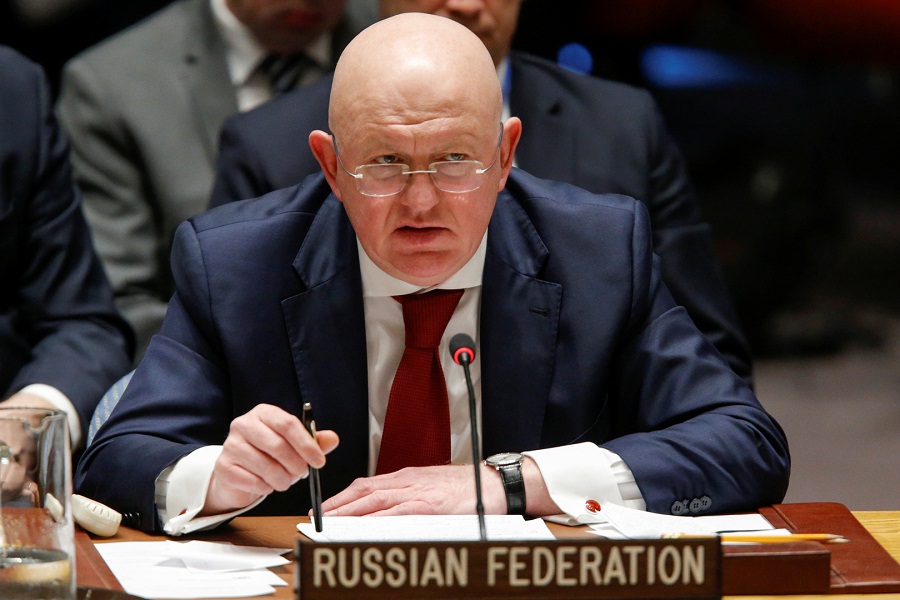
A high-level diplomatic confrontation unfolded at the United Nations Security Council during a briefing session on the situation in Sudan, as deep international divisions emerged over a U.S.-drafted resolution seeking to expand the arms embargo and impose a no-fly zone across all of Sudan, rather than limiting it to Darfur. The proposal faced strong opposition from Moscow and Beijing, while Sudan’s Permanent Representative to the United Nations, Ambassador Al-Harith Idris, launched a forceful counterattack.
Russia took a strongly critical stance toward the Western initiative, describing the U.S. and European sanctions imposed on Sudan as “unacceptable” and portraying them as instruments aimed at pursuing narrow political objectives. Moscow also strongly hinted at the possibility of using its veto to block the U.S. proposal.
China, for its part, urged the Security Council to avoid what it described as indiscriminate sanctions that could further complicate the humanitarian situation. Beijing stressed the need to prioritize a review of previous sanctions imposed by the United States and Europe rather than expanding restrictions, emphasizing that the priority should be inclusive political dialogue rather than additional international pressure.
Sudan’s envoy, Al-Harith Idris, meanwhile, challenged the U.S. proposal, delivering sharp criticism of Washington and its supporters. He said: “None of you would dare ask those who violated the embargo in Darfur and supplied the rebel groups with weapons—and you know who they are.”
Idris highlighted what he described as the hidden implications of the proposal, saying: “The U.S. draft resolution refers in its provisions to expanding the arms embargo beyond Darfur, while they know that the militia is present within the geographic area. This means that the Sudanese Armed Forces, rather than the terrorist militia, are the actual target.”
He questioned the proposal, asking: “How can the U.S. draft equate a national army defending its citizens and its territory with a rebel militia?” He stressed that the Armed Forces are among those involved in protecting civilians and are being targeted for malicious reasons.
Sudan’s envoy also directly criticized countries he accused of contributing to the escalation of the conflict. He said the Panel of Experts had clearly condemned the United Arab Emirates (UAE) for fueling the war in Sudan by supporting the rebel militia, expressing surprise that the panel’s report had yet to be discussed.
He added candidly: “The failure to hold Chad, South Sudan, Ethiopia, and Haftar in Libya accountable for supporting the Rapid Support Forces (RSF) militia is prolonging the war.” He said the ongoing aggression had contributed to the spread of hate speech within Sudanese society.
Idris reaffirmed the Sudanese government’s commitment to its responsibilities to protect civilians, while presenting evidence that the Rapid Support Forces militia and the Sudan People’s Liberation Movement-North (SPLM-N), led by Abdelaziz al-Hilu, had deliberately committed crimes including sexual violence, child marriage, and the recruitment of children against civilians.
The ambassador also outlined Khartoum’s conditions for engaging with ceasefire proposals. These include the complete withdrawal of the rebel militia from cities and civilians’ homes; the formation of a committee comprising Egypt, Saudi Arabia, and the United States to oversee the militia’s disarmament; a reassessment of the militia’s legal status during the ceasefire; and the sponsorship of a nationally owned political dialogue, with support for Sudanese-Sudanese dialogue.
The Sudanese envoy also announced that the President of the Transitional Sovereignty Council (TSC) had formally directed the issuance and renewal of passports for politicians currently residing abroad. He further said that the Armed Forces were operating according to a comprehensive plan to restore security in vulnerable areas.
The session also featured a strong Arab voice in support of Sudan. Saudi Arabia’s representative affirmed that the Rapid Support Forces militia was continuing to inflict abuses and kill the Sudanese people in an unacceptable manner.
In the same context, Egypt’s representative criticized what he the international community’s weak response, stressing that international hesitation to deal decisively and firmly with the RSF’s violations against the Sudanese people was a direct and immediate cause of the tragic situation now facing the country.