
TSC Vice-President: South Sudan Vice President Involved in Supplying RSF Militia
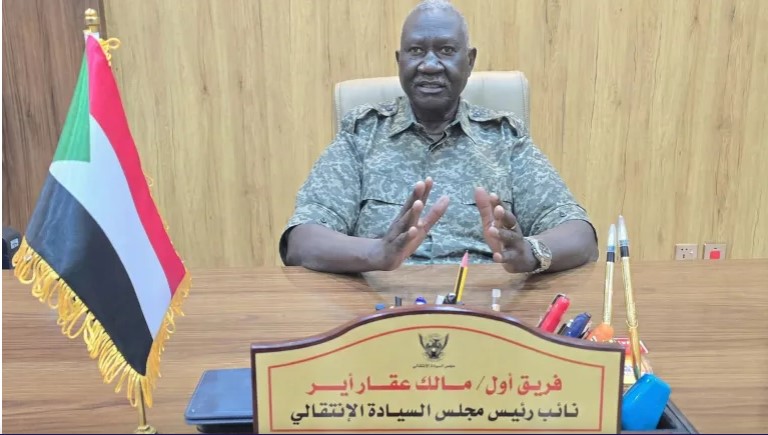
Vice-President Transitional Sovereignty Council (TSC) Malik Agar accused influential leaders in South Sudan of colluding to deliver supplies to the Rapid Support Forces (RSF) militia.
In an interview with Al Jazeera Net, TSC Vice-President Agar said South Sudan Vice-President Taban Deng and some former security officials were involved in facilitating support to the rebellion. He added that the supplies reaching those forces do not represent official policy of the South Sudanese state.
Agar disclosed that during his recent visit to Juba he discussed the flow of supplies to the militia through South Sudan, noting that about 350 fuel trucks were monitored entering via Bahr Al-Ghazal, along with other materials. He said meetings with southern security agencies concluded that they are unable to fully halt the support or control it due to the vast border areas.
Meanwhile, Agar denied knowledge of any move to dissolve the Sovereignty Council and appoint General Abdel-Fattah Al-Burhan as President of the Republic. He said such a step would require amendments to the Constitutional Document and the Juba Peace Agreement, which he noted supersedes the constitution, adding that dissolving the Council would be a negative step that would not help stabilize the country.
Furthermore, Agar voiced concern about the risk of Sudan’s partition, saying Sudan is “not a state but an open prison of ethnicities,” and warning that collapse in any one region would quickly spread to others. He said dividing any part of the country would lead to broader fragmentation and state failure.
He stressed the need for a military breakthrough on the ground before any negotiations begin, arguing that talks at the present time would signal movement toward partition. He rejected the idea that negotiations would lead to a new partnership with the RSF, stating that whoever prevails militarily would dictate the terms of any talks.
In a related remark, Agar described the alliance between Abdelaziz Al-Hilu and RSF commander Mohamed Hamdan Dagalo (Hemeidti) as a fragile, opportunistic tactical alliance. On the future of the RSF, he said the matter is complex but asserted that the Sudanese people would not accept their continued presence, adding that no Sudanese leader could agree to sit with them in line with public sentiment.
He nevertheless indicated that some form of settlement will ultimately be unavoidable, saying it is too early to define its shape, but that at some stage a degree of consensus — even if tactical or formal — is likely to emerge.