
Despite Daily Fighting, “Al-Fashir Takiyah” Defies the Odds and Continues Serving Daily Meals
Al-Fashir – Sudanese Echoes
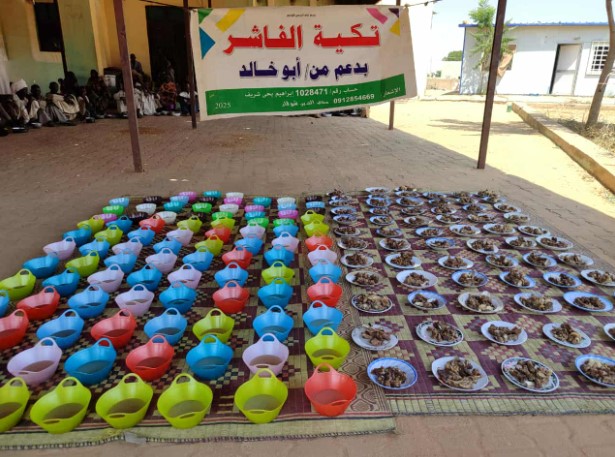
Responding to humanitarian needs during wartime represents one of the most complex and challenging tasks, due to the security and logistical impediments that accompany conflicts and hinder those working to assist others in such dire circumstances. Yet, despite these obstacles, humanitarian efforts continue for those displaced or stranded by the fighting. These difficult conditions often compel aid workers to risk their own lives to save others. Such is the example witnessed by SUNA during a field visit to the “Al-Fashir Takiyah” — a community kitchen initiative led by volunteer Mohy-Eddin Shawgar at Center No. (1), which continues to embody the spirit of humanity with the dedication of selfless young men and women determined to uphold the right to life and to feed the hungry among children, women, and the elderly — amid dire and dangerous circumstances.
Enormous Challenges Facing Al-Fashir Takiyah
The supervisor of the Takiyah, Burai Abdullah Haran, told SUNA that the initiative currently faces enormous challenges in providing just one meal a day to between 350 and 400 families.
He explained that the foremost of these challenges is the ongoing clashes between the Sudanese Armed Forces (SAF)band the Rapid Support Forces (RSF) militia, along with heavy artillery shelling and drone strikes, and the continued siege of the city by RSF militias loyal to the Dagalo group. Haran noted that the siege has emptied all city markets of essential food items, rendering them completely nonfunctional.
As a result, foodstuffs have either disappeared entirely or become scarce, driving prices to astronomical levels due to middlemen’s interference. Moreover, there is a large disparity between cash and electronic payments, with e-payments costing up to 100% more than cash.
Haran stated that the most recent prices dealt with by the Takiyah included 5.5 million Sudanese pounds (1 billion in old currency) for a sheep weighing between 15–20 kilograms, 15 million pounds for a 30-pound carton of cooking oil, and 540,000 pounds for one kilogram of rice — when available. He added that the daily cost of preparing meals for the beneficiary families ranges between 25 and 30 million pounds.
Risking Lives for Others
Despite these dire conditions, Haran said that volunteers at the Takiyah are often forced to venture outside Al-Fashir to procure food supplies directly from traders who bring them from distant areas — a journey fraught with extreme danger. According to him, RSF elements have not hesitated to kill anyone attempting to bring even small amounts of food, such as a kilogram of sugar, into the city.
Volunteers Injured in the Line of Duty
“In spite of all these circumstances, we in the Takiyah have pledged to continue our humanitarian mission,” Haran affirmed. “We remain committed to providing one meal daily, though there are occasional interruptions due to lack of supplies or security issues.” He added that four volunteers have been injured while performing their humanitarian duties.
Methods of Food Distribution
Haran explained that the Takiyah has adopted a new method of distribution to reach displaced families in their locations rather than gathering them at the Takiyah center, as RSF forces have begun targeting any civilian gatherings in Al-Fashir — including those organized for purely humanitarian purposes — with artillery or drone strikes. For this reason, volunteers now deliver prepared meals directly to displacement centers, carefully choosing safe windows of time and distributing the food quietly and discreetly.
Support for the Takiyah
Al-Fashir Takiyah Supervisor expressed deep gratitude to philanthropists from across the world, particularly from Islamic and Arab countries, as well as to Sudanese citizens at home and abroad, including Darfur and Al-Fashir community associations worldwide, for their generous contributions. He urged them to continue their support so that the Takiyah can sustain its critical role in serving Al-Fashir’s residents, who he said have been cut off from all means of survival and now depend on such initiatives for communal meals.
Haran concluded by expressing hope that the war will soon come to an end, lifting the siege on Al-Fashir so that all may enjoy peace, security, and a dignified life once again.