At Abu Dhabi’s Direction, “Addis Ababa” Forces Reject Al-Burhan’s Dialogue and Propose Alternative Track
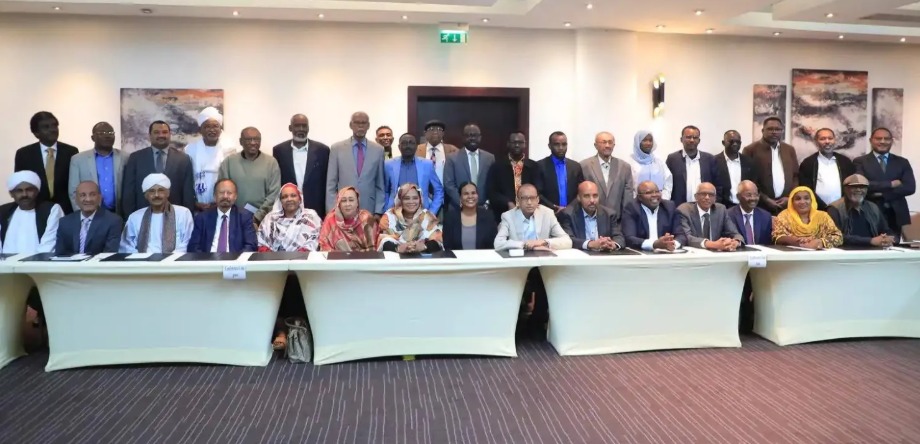
After two days of deliberations in the Ethiopian capital, Addis Ababa, a group of Sudanese political and civil forces announced their rejection of an invitation from the President of the Transitional Sovereignty Council (TSC) General Abdel Fattah Al-Burhan to participate in an internal Sudanese dialogue, arguing that the initiative would entrench the de facto partition of Sudan.
The opposition political forces, particularly the alliance led by former Prime Minister Abdalla Hamdok, known as Somoud, are subject to the influence of the United Arab Emirates (UAE), which the groups accuse of sponsoring the war in Sudan and supporting the Rapid Support Forces (RSF) militia.
The deliberations brought together forces involved in the Nairobi Declaration, including the Somoud alliance, the Sudanese Ba’ath Arab Socialist Party, the Sudan Liberation Movement led by Abdel Wahid Mohamed Nour, the Umma Party led by Mubarak Al-Fadil, as well as independent national figures and civil, women’s and youth organizations.
In a statement issued Sunday, the participating groups claimed that any political process conducted from territory controlled by one of the warring parties and under its protection would seek to confer political legitimacy on military rule and enable members of the ousted regime to regain influence.
Al-Burhan announced in mid-August that he had formally accepted an initiative put forward by a group of Sudanese citizens to launch an inclusive Sudanese-led dialogue inside the country, involving all political and civil forces. He also pledged to provide temporary legal immunities for participants.
The political and civil forces participating in the Addis Ababa discussions agreed on a joint document entitled “The Peace Process We Want.”
The document stressed the importance of simultaneously linking the humanitarian track, a ceasefire and the political process, with the latter to be conducted through equal-footing negotiations under an independent and mutually agreed framework.
The document identified the participants in the political process as civil and political forces opposed to the war, as well as forces aligned with the Sudanese government and the RSF militia.
The Sudanese groups also agreed that the two warring parties should be confined to the humanitarian and security tracks and excluded from the political track.
They called for the complete exclusion of the National Congress Party and its Islamic Movement umbrella from any participation in the peace process.
The joint document described the roadmap proposed by the Quad, comprising the United States, Saudi Arabia, the United Arab Emirates and Egypt, in August of last year as the preferred framework for the peace process.
The political and civil forces expressed their full readiness to engage constructively with the Quintet mechanism, while emphasizing full Sudanese ownership of the decision-making process. They also called for coordinating the efforts of the Quad, the Quintet and the Troika countries within a unified framework to strengthen collective pressure for an end to the war.
The groups further agreed to establish a joint committee tasked with developing understandings among anti-war forces and coordinating their positions.