
Al-Burhan Sets Conditions for Ending the War and Announces Formation of Parliament
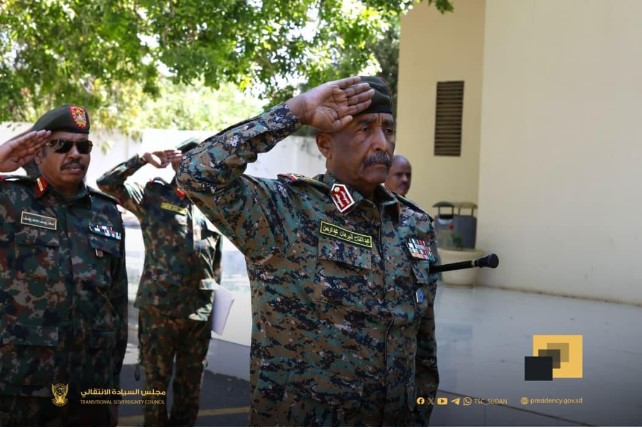
President of the Transitional Sovereignty Council (TSC) and Commander of the Sudanese Armed Forces (SAF), General Abdel Fattah Al-Burhan, said that Sudan is facing a test threatening its state sovereignty, stressing that the current crisis cannot be seen merely as a clash between two armed groups.
In an article published in the Turkish magazine Almanac Diplomatique on Sunday, 25 January 2026, Al-Burhan emphasized that the priority is to preserve Sudan’s territorial unity and ensure the continuity of the state, asserting that the will of the Sudanese people must take precedence over any “militia logic” or influence networks tied to personal interests or external affiliations.
He added that the Sudanese Armed Forces bear a historical and constitutional responsibility to prevent the imposition of coercive realities that could push the country toward fragmentation, and to restore a minimum security environment that allows for a feasible civilian transition.
Regarding the restoration of peace in the country, Al-Burhan said that calls for a ceasefire and the launch of negotiation tracks in Sudan are necessary, noting that the negotiation table only gains meaning if it is based on clear principles.
Al-Burhan reiterated the Sudanese government’s conditions for a ceasefire: withdrawal from occupied areas, removal of heavy weapons from the conflict equation, and ending any separate power centres operating outside the state’s official chain of command.
On foreign interventions and regional calculations, Al-Burhan said Sudan’s stance is clear: “Sudan is for Sudanese, and no settlement should be shaped on the basis of externally imposed equations, but through a Sudanese-to-Sudanese dialogue rooted in national priorities.”
He confirmed the involvement of some foreign parties in supporting the Rapid Support Forces (RSF) at various levels, based on field realities and available data.
Addressing the humanitarian catastrophe, Al-Burhan said that civilians are paying the heaviest price for this war, noting that international reports indicate tens of millions of people have been forcibly displaced since the outbreak of the conflict.
Al-Burhan also highlighted that relations between Turkey and Sudan are historical and deeply rooted in a spirit of brotherhood, praising Turkey’s efforts to keep Sudan on the international agenda and to show solidarity with the Sudanese people.
He added that the next phase is not only about halting the fighting, but also represents a stage of rebuilding Sudan, which will encompass a wide range of sectors: from infrastructure and energy to agriculture and ports, and from healthcare and mining to education.
He continued: “For this reason, we are considering facilitative measures, such as improving the visa system for businesspeople, to open the way for investment and trade.”
Al-Burhan concluded his article by stating that Sudan’s goal is clear: to re-establish the authority of the legitimate state, ensure the protection of civilians, and advance toward an inclusive political process grounded in solid security.