“Al-Burhan” Attacks Trump Advisor, Rejects Quadruple Initiative Proposals
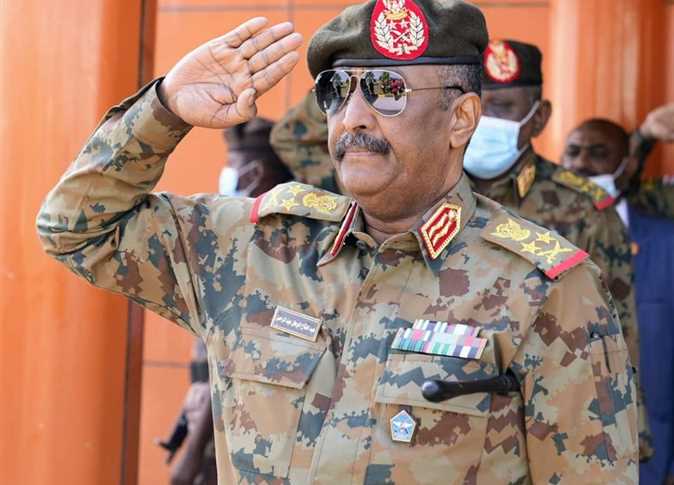
President of Sudanese Transitional Sovereignty Council (TSC) Abdel-Fattah Al-Burhan on Sunday announced his rejection of the proposals submitted by the Quadruple Mechanism to resolve the ongoing crisis, stating they called for the dissolution of the army and security agencies while allowing the Rapid Support Forces (RSF) militia to remain. He also stressed that the initiative’s mediation is unacceptable as long as the United Arab Emirates participates.
Al-Burhan addressed senior military officers of major general rank and above, in the presence of his aides Yassir Al-Atta and Ibrahim Jabir, as well as the Chief of Staff and his deputies, the deputy directors of the police and the General Intelligence Service, and a representative of the joint forces.
During his address, Al-Burhan said the Quadruple Mechanism had submitted three negotiation papers, while Massad Boulos, advisor to the U.S. President for African affairs, submitted a new paper about two weeks ago that failed to take into account the government’s concerns raised in earlier submissions.
He described the latest paper as the worst, as it calls for dissolving the army and security agencies while keeping the RSF militia, emphasizing, “We will not accept this.”
Al-Burhan added that if the Quartet Mechanism continues along this path, its mediation would be considered biased—particularly due to Massad Boulos, whom he criticized for trying to impose solutions.
“Boulos speaks as if he wants to force certain conditions upon us. We fear he could become an impediment to the peace we seek, and he threatens to discuss blocking government aid and the use of chemical weapons,” he said.
He stressed that the negotiation paper presented by the Quadruple Mechanism is unacceptable, affirming that Sudan’s crisis can only be resolved through the roadmap proposed by the Sudanese government.
Al-Burhan noted that the initial negotiation paper did not merit public release as it contradicted the principles of the Sudanese state and the aspirations of the military. He explained that the government responded to the initial paper with a roadmap to end the war, based on the withdrawal of the RSF militia from areas it seized after the Jeddah platform, regrouping them in agreed locations, paving the way for the return of displaced persons (IDPs), delivery of aid, and reconstruction, followed by negotiations.
He added that the government also responded to the second negotiation paper with a roadmap centred on withdrawal, regrouping, normalization, the return of IDPs, and launching Sudanese–Sudanese dialogue.
Islamist Influence
Al-Burhan reiterated his rejection of the United Arab Emirates’ (UAE) participation in the Quadruple Mechanism, saying, “If the UAE is part of the Quad, it is not neutral; it supports the rebellion. How can we accept it as a mediator?”
He condemned remarks by U.S. advisor Massad Boulos and some political leaders—without naming them—about the alleged control of the army and state by the Muslim Brotherhood, noting that the UAE has consistently propagated this narrative.
He added, “This is merely a scare tactic used for the Americans, Saudis, and Egyptians. It is entirely false and a blatant lie.”
Al-Burhan affirmed that the military is capable of reforming and restructuring its own institution.
Saudi Role
He said that Saudi Crown Prince Mohammed bin Salman had briefed U.S. President Donald Trump on the real situation in Sudan, welcoming this step.
Al-Burhan expressed hope that Trump’s initiative would address the aspirations of Sudanese people who have suffered the ravages of war, describing it as an opportunity to spare Sudan from destruction and fragmentation, and announcing his readiness to engage with it to end the war in an ideal manner.
Last week, Trump announced his intention to assume presidential authority to end the war, following an invitation from Mohammed bin Salman during his visit to Washington.
Al-Burhan stressed that no initiative would be acceptable if it allowed the RSF to remain, asserting that peace cannot be achieved while it occupies territories.
Border Breaches
TSC President pledged to restore control over Kordofan and Darfur and expel the RSF militia from Sudan, emphasizing that the battle is one of survival.
He clarified that the army does not fight tribes or local communities and urged tribal leaders not to be swayed by RSF deputy commander Abdel Rahim, who recruits community members for money.
Al-Burhan denied that the government obstructed aid delivery, noting that it approved air drops in Al-Obeid, Al-Damazin, and Kadugli, and from the air in El-Fashir. He also highlighted that the route from Port Sudan to Al-Dabbah and El-Fashir is shorter than routes via Cameroonian ports to Darfur, suggesting ulterior motives behind criticisms.
He condemned UN and NGO operations in Darfur without government authorization, stressing that their actions, even if intended to serve Sudanese citizens, violate sovereignty and constitute a breach of borders.