Al-Burhan: Those Who Advise Us to Surrender Should Today Urge the Militia to Surrender
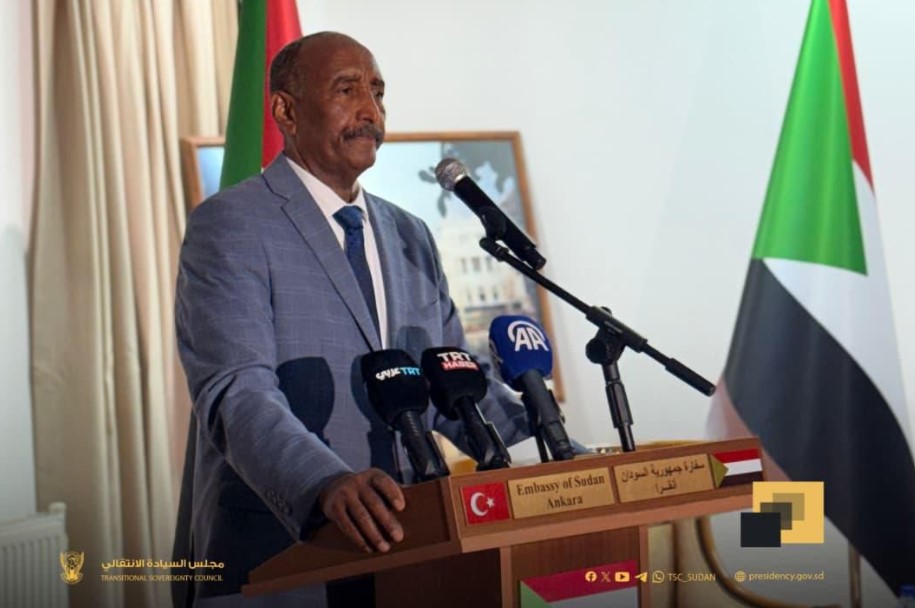
President of the Transitional Sovereignty Council (TSC), Abdel Fattah Al-Burhan, said the government rejected the Quartet initiative due to the presence of the United Arab Emirates (UAE) within the international mechanism, noting that an end to the war is contingent upon eliminating any presence of the “rebel militia,” politically and militarily.
Al-Burhan renewed his sharp criticism of the civil and political forces that signed the political agreement with the militia in Addis Ababa in January 2024, stating, in remarks delivered from inside the Sudanese Embassy in Turkey, according to a video clip circulating on social media, that those who signed the agreement with the “rebel militia” believed that military superiority would be in the militia’s favour. He added that once the armed forces regained their balance, these voices rose to demand an end to the war so that the armed forces would return to the Sudanese state and to the political framework.
Al-Burhan stressed that the way out of the crisis must be through “Sudanese-Sudanese dialogue,” and said the army will not stop fighting the “rebels” unless they “lay down their weapons.”
Al-Burhan revealed, in an interview, information about a phone call that took place between him and the Ruler of the United Arab Emirates, Mohammed bin Zayed, last year, during which the latter pledged to stop what he described as the “aggression” against Sudan, but these promises were not honoured, according to him.
He noted that Sudan confronted the United Arab Emirates, headed by Sudan’s Foreign Minister Mohi-Eddin Salim, in a meeting held in the presence of members of the Quad in the United States of America in recent months. Al-Burhan added: “The UAE delegation was unable to defend itself.”
Regarding the circulating leaks about the launch of hostile military operations against Sudan from Ethiopia, the Commander of the Sudanese Armed Forces and President of the Transitional Sovereignty Council said: “We send a message to the friendly state that Sudan is not weak as some believe, and that it is stronger than it was,” calling on some parties to roll back any steps that could lead to serious mistakes, as he put it.
He went on to say: “You hear about negotiations, and all of us in Sudan know that we want to stop the war, we want Sudanese to return to their cities and villages, and we want stability, but in the presence of this rebel militia and those backing it, this cannot be achieved.”
He said that the “rebellion” is expanding and occupying some areas in Sudan, and in return stressed that he follows the operations on a daily basis, every hour and every moment, adding that he is aware of the situation on the ground and knows the position of the “rebels.”
Al-Burhan said the Sudanese people cannot be easily swayed by malicious propaganda whose objectives are well known, noting that some Sudanese allied with the “rebels” in the early weeks of the war and still do, believing that the battle had been decided in favour of the “militia.”
He continued: “The rebellion expanded and destroyed the Sudanese state, and once the armed forces regained their balance, voices calling for an end to the war rose. These matters have implications that we understand well.”
Al-Burhan made the end of the war in Sudan conditional on eliminating the “enemy,” saying that political action begins after the end of military operations. He added that the Quad had been speaking of the Jeddah Agreement as a reference, but Sudan rejected that due to the presence of the United Arab Emirates.
Al-Burhan stipulated the gathering of the Rapid Support Forces in main camps and their disarmament to stop the war, saying this condition issued by the state has not changed. He added: “The United Arab Emirates provided money, weapons, and mercenaries to the rebels in Sudan, and we have not closed the door to those who offer solutions.”