Khartoum, Juba Agree to Regulate Border Movements and Protect Oil Fields
Sudan and South Sudan announced on Monday that they had reached an agreement on a number of key issues, including regulating cross-border movements, protecting oil fields and pumping stations, and establishing a joint economic committee.
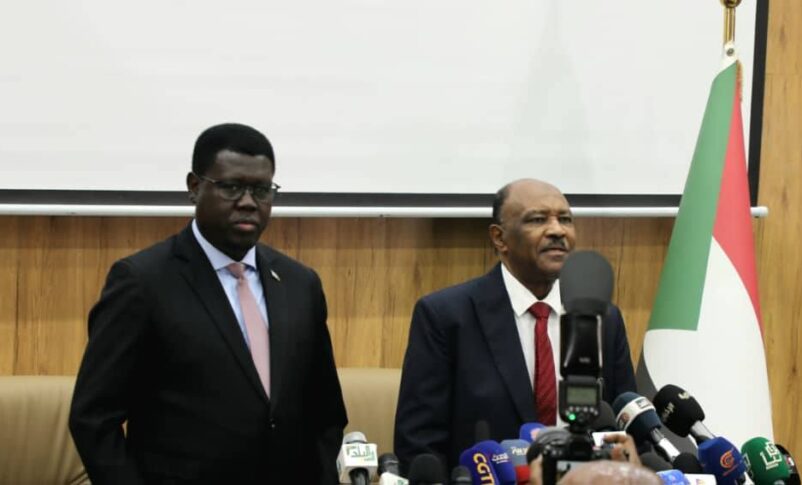
The announcement came in a joint statement read by Sudan’s Minister of Foreign Affairs and International Cooperation, Mohy-Eddin Salim, and his South Sudanese counterpart, Mandy Samaya, at the conclusion of the latter’s two-day visit to Port Sudan.
Speaking at a joint press conference, Minister Salim said the two countries had agreed to regulate and organize movement at border crossings, enhance trade relations, encourage investment, and open banking channels.
He noted that Samaya held meetings with President of the Transitional Sovereignty Council (TSC) General Abdel-Fattah Al-Burhan, Vice-President Malik Agar, and Prime Minister Kamil Idris, in addition to meetings with the Ministers of Interior and Oil, and the Director of the General Intelligence Service.
According to Salim, discussions between the South Sudanese Foreign Minister and Sudan’s Minister of Oil focused on challenges facing the oil and energy sector, where both sides agreed to exchange expertise, increase production, and protect oil fields and pumping stations.
On August 30, oil fields in Heglig, South Kordofan State, came under drone attack, prompting the Sudanese government to warn that it might be forced to suspend operations in the area, which hosts the main processing facility for South Sudan’s crude oil.
Minister Samaya said the two countries agreed to further develop bilateral relations and ensure the protection of nationals in both Khartoum and Juba.
Relations between the two neighbors had experienced a diplomatic crisis in February 2025, following a wave of retaliatory violence in Juba and other cities that left 16 Sudanese citizens dead, with Sudan accusing South Sudan of incitement.
Earlier, Juba had called on the UN Security Council and the African Union to support its request for a credible investigation into alleged killings of South Sudanese nationals in Wad Madani, Al-Gezira State, after the Sudanese army took control of the city on January 11.
Samaya added that both foreign ministries agreed to reactivate political consultation mechanisms and continue cooperation in the fields of counterterrorism, intelligence sharing, and border security.
On August 12, TSC Vice-President Malik Agar had discussed with President Salva Kiir Mayardit and his deputy for economic affairs, Benjamin Bol Mel, the importance of enforcing strict border control to curb the movement of armed groups accused of destabilizing Sudan.
Samaya revealed that the two countries agreed to establish a joint economic committee to enhance cooperation in trade, investment, energy, oil, agriculture, and transport.
He further stated that the agreement includes facilitating trade and investment movement, including the allocation of a free zone at Port Sudan for South Sudan to be used for oil industry development and equipment, as well as for facilitating transit goods to Juba.
Finally, Samaya announced that the two sides agreed on reciprocal ministerial visits, with Sudan’s Ministers of Foreign Affairs, Interior, and Oil expected to visit Juba, while South Sudan’s Vice-President for Economic Affairs, Minister of Trade and Industry, and a delegation from the Ministry of Petroleum will visit Sudan.