Sudanese Authorities Tighten Security Measures in Khartoum
The Sovereign Committee announced strict measures to maintain security and impose state prestige in the capital, Khartoum.
It also called on residents to avoid dealing with foreigners who do not hold official residency documents.
The committee held a meeting chaired by Ibrahim Jabir, attended by the Ministers of Defense, Interior, Energy and Oil, Federal Governance, Youth and Sports, as well as the Wali (governor) of Khartoum State and members of the committee responsible for security and enforcing state authority.
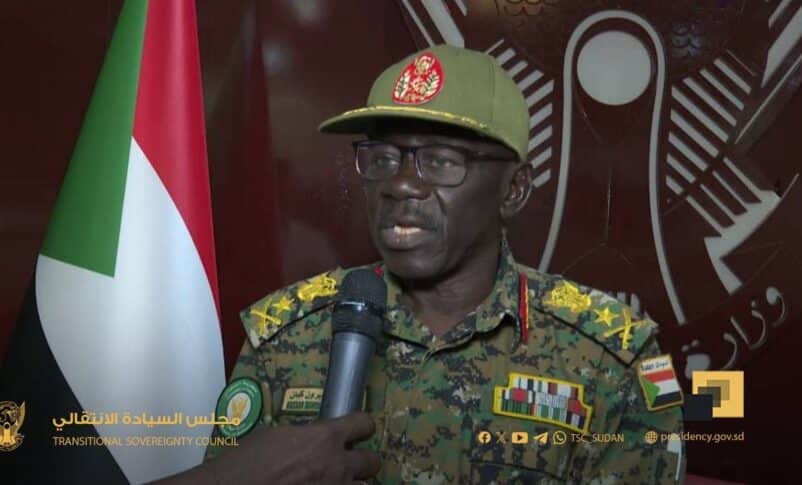
Defense Minister Hassan Dawood Kabron, who heads the security committee, told reporters that the committee “emphasized banning the carrying of weapons and wearing military uniforms in neighborhoods and public places in Khartoum.”
He added that the committee decided to prohibit the use of unlicensed motorcycles and vehicles within Khartoum, noting that most reported robbery cases in police stations involve such means.
Kabron confirmed that the committee is moving forward with enforcing security measures to stabilize the situation and impose state prestige in Khartoum.
Reports of armed robbery and homicide have increased in the capital, where authorities are working to restore water, electricity, health, and education services, as well as rebuild infrastructure extensively damaged during the RSF’s control of the state.
The defense minister urged owners of lost vehicles to cooperate with authorities in locating and removing them from roads and public squares. He also noted that the Public Prosecution is preparing to issue legal orders to deal with abandoned vehicles.
The minister called on citizens not to deal with foreigners lacking official residency documents, urging embassies and diplomatic missions in Sudan to regularize the status of their nationals. He stressed that Sudan is in a state of war, necessitating strict measures regarding foreign presence.
Authorities in Khartoum have relocated foreigners, particularly refugees, to border camps after some, mainly from South Sudan, were involved in fighting alongside the RSF against the army.
The head of the security committee instructed security forces not to obstruct the work of the informal housing removal committee, warning that any obstruction would be considered a violation of state directives subject to legal accountability.
Citizens were urged not to establish new informal settlements, as the authorities remain firm on enforcing the ban to combat security threats and prevent the spread of prohibited activities.
Khartoum authorities have actively removed informal houses and shops from residential neighborhoods, markets, and hospitals.