
Egyptian President Directs Facilitation of Sudanese Citizens’ Movement and Repatriation of Prisoners
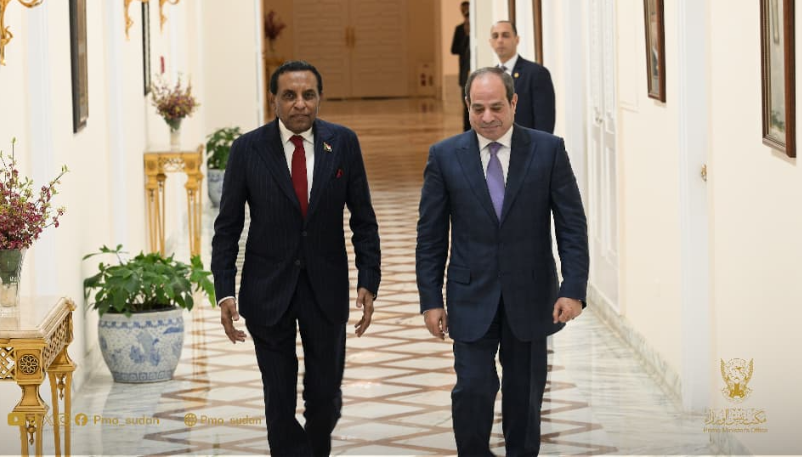
In a significant step reflecting the transition of Sudanese-Egyptian relations from political solidarity and diplomatic coordination to joint action and tangible strategic projects, the Egyptian capital, Cairo, witnessed high-level diplomatic activity on Tuesday, marked by a working visit by Sudan’s Transitional Prime Minister, Professor Kamil El-Tayeb Idris, heading a high-level government and security delegation.
The visit culminated in a summit meeting with Egyptian President Abdel-Fattah El-Sisi at Al-Ittihadiya Palace, followed by extensive consultations with his Egyptian counterpart, Dr. Mostafa Madbouly.
The visit concluded with the issuance of a joint statement carrying decisive messages on security, political, economic and humanitarian issues, placing the file of Sudan’s reconstruction at the forefront of the priorities for the coming phase.
At Al-Ittihadiya Palace, Egyptian President Abdel Fattah El-Sisi received the Sudanese Prime Minister, who delivered a written message from the President of the Transitional Sovereignty Council, (TSC) General Abdel-Fattah Al-Burhan.
During the meeting, attended by the foreign and information ministers, the Deputy Governor of the Central Bank of Sudan, and senior security officials from both countries, El-Sisi affirmed that the historical and geographical ties between the peoples of the Nile Valley transcend any attempts at temporary disruption through social media platforms. He stressed Cairo’s full support for Sudanese state institutions as the country embarks on the reconstruction phase.
The Egyptian President directed that the voluntary return of Sudanese citizens be given priority and that movement between the two countries be facilitated. He also directed the implementation of a plan to repatriate Sudanese prisoners held in Egyptian prisons to Sudan, where they would serve the remainder of their sentences in their home country.
For his part, Sudanese Prime Minister Professor Kamil Idris affirmed Sudan’s keenness to develop relations with Egypt, activate the work of joint committees and expand areas of cooperation, particularly in the economic field. He noted that the main objective of his visit to Cairo was to formally launch the process of Sudan’s reconstruction, opening new horizons for cooperation and partnership between the two countries.
Idris summed up the philosophy behind his visit by saying: “We are brothers, partners and allies.” He stressed that the visit was aimed at formally launching the reconstruction process and moving from words to action. He also presented to the Egyptian President his government’s vision for launching the “Sudanese-Sudanese Dialogue” as an inclusive national process that excludes no one and lays the foundation for national healing. He called on Egypt to support Sudan in regaining its active role and standing within the African Union and continental institutions.
At the level of government talks, Egyptian Prime Minister Mostafa Madbouly and his Sudanese counterpart held an extensive consultation session that resulted in a joint statement adopting a firm position on the threats facing the Sudanese state.
Cairo reaffirmed its commitment to the principles outlined in the Egyptian Presidency’s statement issued on December 18, 2025, concerning the direct link between the national security of the two countries. It also declared its categorical rejection of the establishment or recognition of any parallel entities in Sudan.
The joint statement affirmed Egypt’s full readiness to take all measures and steps permitted under international law and the Joint Defence Agreement between the two countries to ensure that these “red lines” are not crossed.
The two sides also strongly condemned attacks by the rebel Rapid Support Forces (RSF) militias against civilians and infrastructure, particularly electricity stations and water facilities, using drones launched from a neighbouring country. They affirmed their support for the Sudanese Armed Forces in fulfilling their constitutional duty to protect the country’s borders and resources.
Economically and developmentally, the consultations opened the door for Egyptian companies to contribute to rebuilding what the war has destroyed in Sudan, particularly in the industrial and agricultural sectors and the rehabilitation of infrastructure. These efforts will run alongside plans to increase trade exchange and strengthen cooperation in the healthcare sector and pharmaceutical industries.
On service-related and legal issues, the two prime ministers agreed to address the situation of detainees held by both sides as soon as possible and continue coordination to facilitate the voluntary return of Sudanese citizens. Egypt also pledged to remove all obstacles facing Sudanese students and ensure their educational welfare, while Sudan expressed appreciation for Egypt’s historic role in hosting its Sudanese brothers and sisters during their crisis.